
FANUC UK opened the doors of its Ansty Park headquarters near Coventry on 3 and 4 November for a free two-day open house aimed squarely at manufacturers who still think robots are only for the big players. Billed as "Automation That Works For You", the event set out to show how simple, scalable kit can help firms of any size deal with staff shortages, rising energy bills and inconsistent product quality.
It was a deliberately practical affair. Rather than concept machines, visitors were shown robots and machine tools running live, a partner exhibition of more than 30 integrators and suppliers, and a programme of panel debates in which manufacturers, academics and industry bodies talked frankly about what it takes to get started.
The UK debut of an 11kg welding cobot
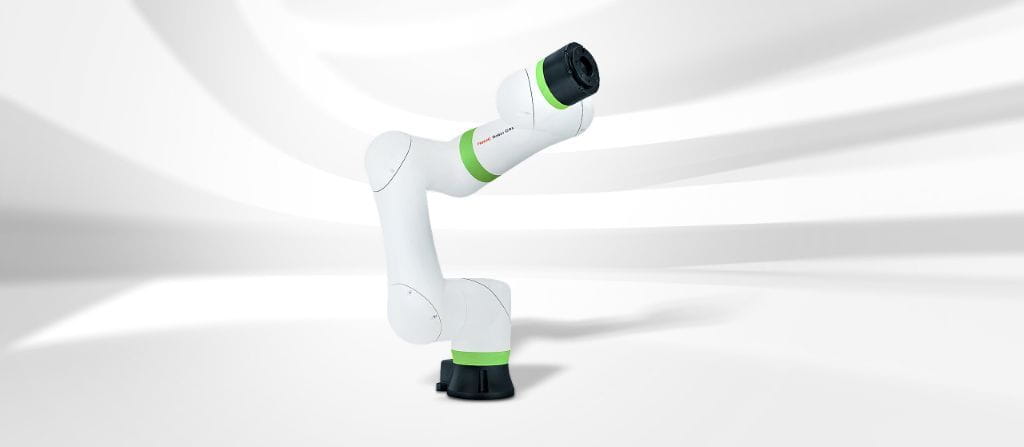
The headline act was the CRX-3iA, the smallest and lightest model in FANUC's CRX range of collaborative robots, making its first UK appearance. FANUC announced its European launch in July. The whole robot weighs just 11kg, so one person can carry it in one hand, and it handles a 3kg payload with a repeatability of ±0.02mm.
FANUC is pitching it first and foremost at welding. The payload is enough to carry a welding torch and a seam-tracking sensor at the same time, and the company says one person can supervise several welding locations by moving the robot between them. After it is relocated, the CRX-3iA works out its own installation angle and, with a third-party laser scanner or touch sensor, finds the weld seam and calculates its path. An optional magnetic base lets it clamp directly onto large steel structures, which FANUC says cuts out much of the heavy equipment and extra safeguarding that a traditional robot installation would need.
The target markets are sectors such as shipbuilding and steel construction, where FANUC points to a Europe-wide shortage of skilled welders. "Manufacturers need automation that adapts to their environment, not the other way around," said Paul Ribus, FANUC's head of sales coordination for Europe, when the robot launched. "With the CRX-3iA, we focused on portability, fast deployment and high repeatability."
Welding is not the only job in mind. FANUC also suggests the arm for intralogistics and for mounting on automated guided vehicles, where its low weight and small footprint suit picking, placing and line-supply tasks. It is also aimed at colleges and training centres, where a full-size industrial robot is often impractical. Like the rest of the CRX family, which runs up to a 30kg payload and 1,756mm reach, it uses FANUC's standard controls and software, and operators can teach positions by guiding the arm by hand using buttons on its wrist.
Live demos and a crowded partner hall
Around the new cobot, FANUC ran live demonstrations of what it calls "first step" automation: CRX cobots handling entry-level palletising and simple welding jobs. ROBOSHOT all-electric injection moulding machines and ROBODRILL compact machining centres were also running, alongside FANUC's CNC controls and factory automation systems.
The partner exhibition covered sectors from engineering, food and packaging to pharma, plastics and toolmaking. Exhibitors listed on the event site included Zimmer Group, Fronius, Festo, Hexagon, Güdel, Colchester Machine Tool Solutions, INSPHERE, NIKKEN, Loop Technology, SCHUNK, SMC, Schmalz and Reeco Automation. Trade body Automate UK attended too, along with Automate BEST, its charitable skills and apprenticeships arm.
Skills: change the image and keep the people
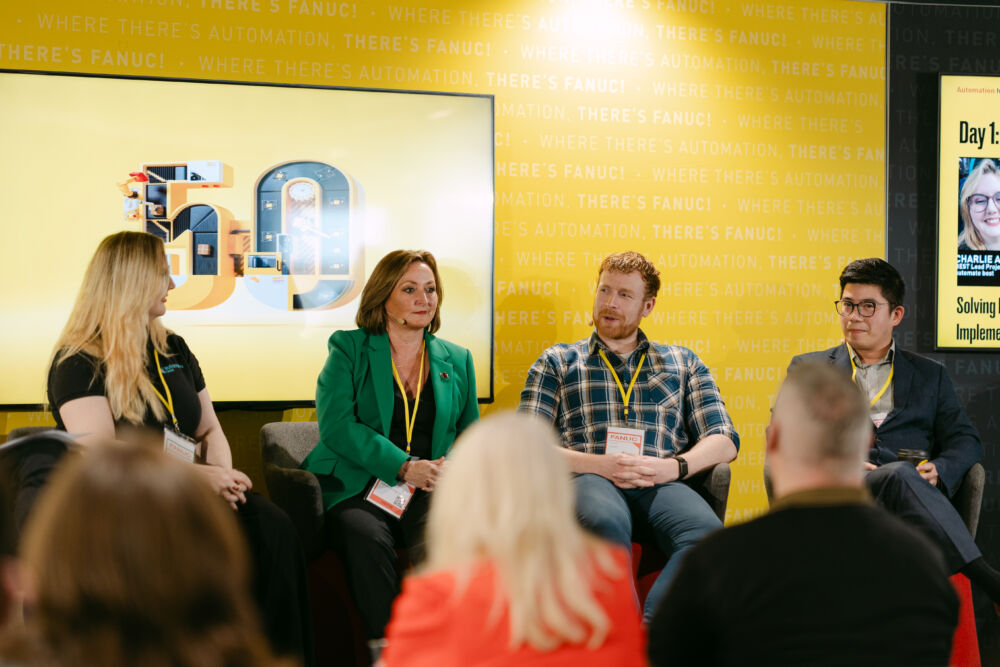
The debate was as lively as the hardware. A panel on labour challenges and culture change brought together Andrea Wilson, founder of ManufacturingUK.org; Sam Baynham, founder of the supply-chain network ConeX; Dr Gilbert Tang of Cranfield University; and Charlie Allen, lead project manager at Automate BEST.
They agreed that the sector needs to do more to challenge outdated perceptions of manufacturing and to show off the technology that actually defines it today, as a way of drawing more young people into engineering careers. But the panel was equally clear that new recruits are only half the answer. Keeping existing staff, and upskilling them in automation, AI, machine vision and robotics, matters just as much, as does encouraging mentoring and collaboration between generations on the shop floor.
FANUC UK managing director Andy Armstrong tied that back to the company's own role. "At FANUC, we are dedicated to supporting manufacturing firms to increase their productivity and competitiveness through automation," he said. "This also includes helping to train their workforces to get the most out of their equipment, to ensure they have the skills needed to compete in an international marketplace."
Getting started: begin with the problem
An earlier panel focused on how firms can take their first steps and get a return on their investment. The advice was refreshingly unglamorous: focus on the operational problem rather than the technology, start small to build confidence, involve staff from the outset, and work with the automation supply chain to take the risk out of the process. Other sessions on the programme covered real-world return on investment and what new cyber resilience and machinery regulations mean for manufacturers.
Host and moderator Thomas Flude summed up the mood bluntly: "If we don't automate, we don't compete."
Why it matters
The open house was pitched squarely at small and medium-sized manufacturers, the backbone of British industry and often the firms least likely to have automated. Ahead of the event, Armstrong argued that today's systems are far simpler than the complicated robotic cells of the past, and can be fitted into existing lines alongside older machinery. He also pointed out that the UK sits outside the world's top 10 manufacturing nations by output, and said automation is no longer a nice-to-have for British manufacturers but a business necessity.
FANUC UK's head of sales, Dan Fisher, described the event as a must-attend for any UK SME looking to improve product consistency, increase efficiency and ease staffing problems. Whether smaller firms take up the offer is the real test, but the direction of travel was clear: automation is being sold as something a modest factory can start with today, using a robot one person can carry, rather than as a big-company project.
The Ansty Park site stayed busy after the doors closed, hosting the annual BARA robotics conference on 5 November.