
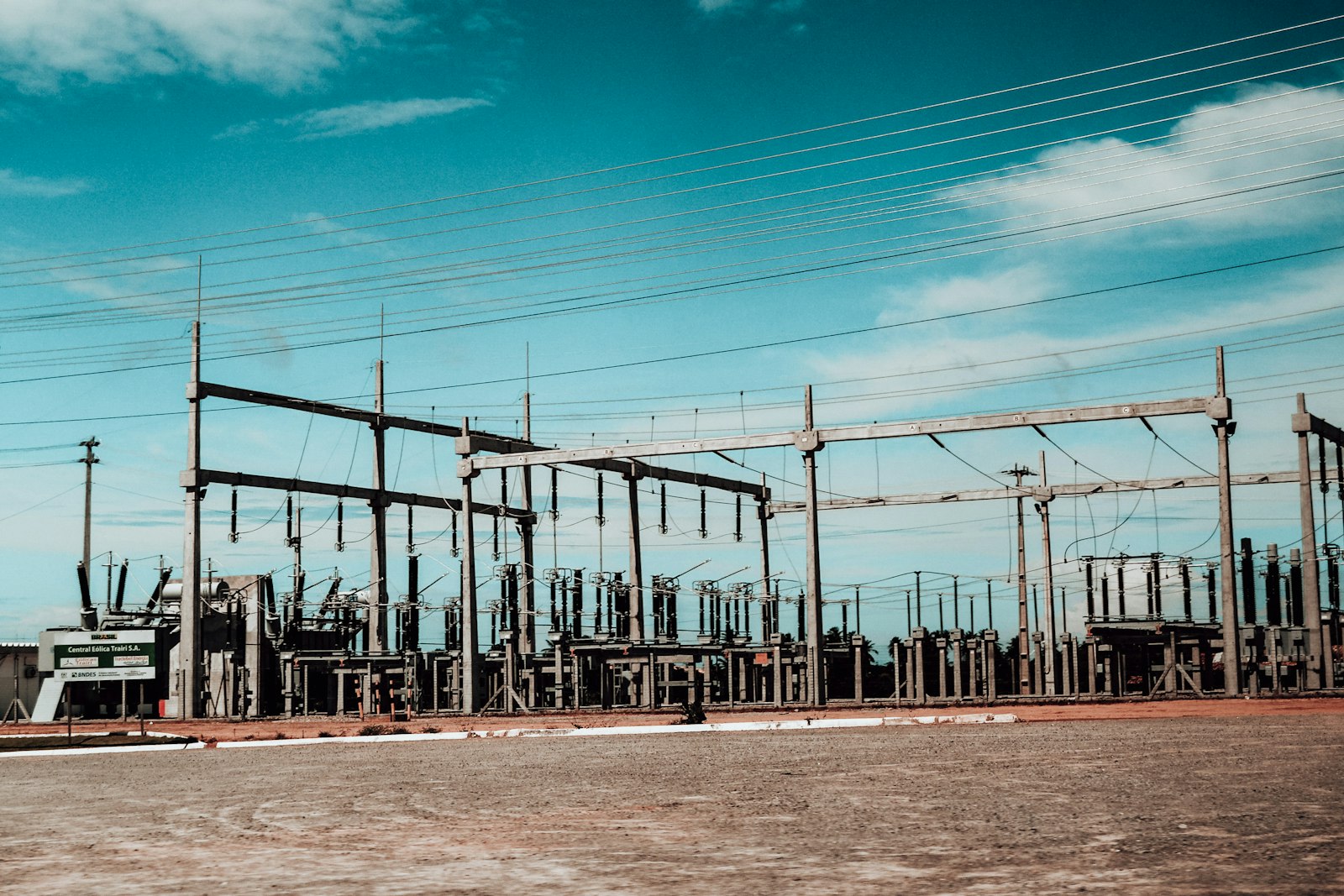
Britain's AI ambitions have a power problem, and on Teesside someone has just started to deal with it. National Grid has agreed to buy 73 acres of land at Dorman Point, on the Teesworks site near Redcar, for a substation that is expected to be the largest in the UK. Its job is to feed electricity to a vast AI data centre planned next door.
The land deal was first reported by Sky News on Sunday and picked up by the Guardian and trade press. Teesworks, the public-private partnership that owns the site, says the agreement was reached on 28 October. It matters because grid connections, not chips or capital, are now the thing most likely to decide where Britain's AI infrastructure gets built.
What National Grid has actually bought
National Grid Electricity Transmission has agreed to purchase 29.5 hectares, or 73 acres, at Dorman Point. The plot sits directly beneath both 275kV and 400kV overhead transmission lines, which is exactly where you want a major substation: the power is already overhead.
The new site will host what is called Teesside Node A. According to Teesworks, National Grid's contractor Balfour Beatty will build it, and National Grid will supply an additional 1.44GW from it to Steel River Power, the company that owns and runs the private electricity network across the Teesworks estate. Teesworks compares 1.44GW with the combined demand of Greater Manchester and Glasgow. The Guardian was more cautious on the contractor, reporting only that Balfour Beatty was in line to deliver it, with Steel River Power heavily involved.
The initial capacity is 1,440 MVA, due online by the end of 2029. For scale, Steel River Power's existing network has a capacity of 360 MVA, of which 200 MVA is currently available to businesses and projects on the estate. The new substation would therefore lift available power on the site several times over.
Before any of that is built, Teesworks has to prepare the ground. It says remediation work across the 73 acres will take about six months, after which the land can be handed over to National Grid. Teesworks covers 2,500 acres of former industrial land and describes itself as Europe's biggest brownfield site.
The 3.2GW figure, and what is still unconfirmed
Headlines have quoted "up to 3.2GW", and it is worth being precise about where that comes from. It is the Tees Valley mayor, Ben Houchen, who said that a contracted 1.44GW, with further expansion up to 3.2GW in the near future, would let the region "finally compete" for data centre projects. The contracted figure is 1.44GW. The larger number is an ambition, voiced by a politician, and neither the Guardian nor Teesworks has published a timetable for reaching it.
Nor has anyone named the operator of the data centre itself. The Guardian reports that the government was said last year to have picked Teesworks as the site for a new AI data centre, and that planning applications have been submitted for a project spanning nearly 500,000 square metres. IT Pro puts the figure at more than 462,000 square metres. Sky News said its sources expected it to be among the largest in Europe. We have not seen a confirmed customer, so we are not naming one.
Why power is now the bottleneck
Houchen's quote is the blunt version of an argument made across the industry. "Everyone who's tried to build a data centre ... in this country knows the biggest problem is getting enough power to the site quickly," he said. "While we've been stuck in the queue, the US, the Gulf and parts of Europe have been getting on with it and hoovering up the investment."
That queue has already claimed a high-profile casualty. When Microsoft walked away from a large AI data-centre project at Loughton in Essex over power supply concerns, we looked at what it said about the grid in our report on Microsoft, Nscale and the Loughton power problem. Teesside is the mirror image: a site where the substation is being planned first and the demand is expected to follow.
There is also a policy push behind it. Last week the government published a draft national policy statement on data centres, describing them as "as fundamental to our economy as the railways and electricity networks on which we have long depended". IT Pro adds that last month's Autumn Budget introduced a Data Centre Covenant. Developers would pledge substantial local investment, minimise water and power use and create local jobs, and in return get accelerated access to electricity connections.
The UK angle: jobs, sovereignty and opposition
For Teesside, the pitch is regeneration. Teesworks says the build will lead to thousands of local jobs, and David Smith, chair of the South Tees Development Corporation, called the agreement "a real boost" to attracting future investment. Houchen framed it as national capability: if Britain wants its own AI capacity, "with sensitive data stored safely on British soil", he would "much rather that was Teesside than Texas or Abu Dhabi". We covered the same sovereignty argument in our piece on why advisers warn Britain risks being an AI customer, not a builder.
Not everyone is convinced that more data centres are welcome. The Guardian notes strong local opposition to planned developments from Auchtertool, a village north of Edinburgh, to Brick Lane in east London, and reported in October that AI companies told ministers they had 12 months to head off public opposition or risk US-style protests that could threaten construction. A brownfield industrial site with its own grid connection is far easier to defend than a village field, which may be part of Teesside's appeal.
For ordinary readers, the practical effect is indirect for now. Nobody has yet published what this substation will cost or who ultimately pays, and we will report it if that changes.
What's next
Expect the following milestones, none yet dated beyond what is stated. Remediation of the land runs for roughly six months. The substation's first 1.44GW is scheduled by the end of 2029. The data centre's operator and customers remain to be named, and the draft data-centre policy statement is still only a draft.
The bigger question is whether a single large connection solves the problem or simply shows how scarce they are. Britain's AI industry has spent months arguing that power is what stands between it and the investment going to the US and the Gulf. Teesside is the first test of whether building the grid first can change that.
Related stories
- Microsoft pulls out of Nscale's Loughton site over power
- Britain risks becoming an AI customer, not a builder, advisors warn
- Britain's £600m AI package