
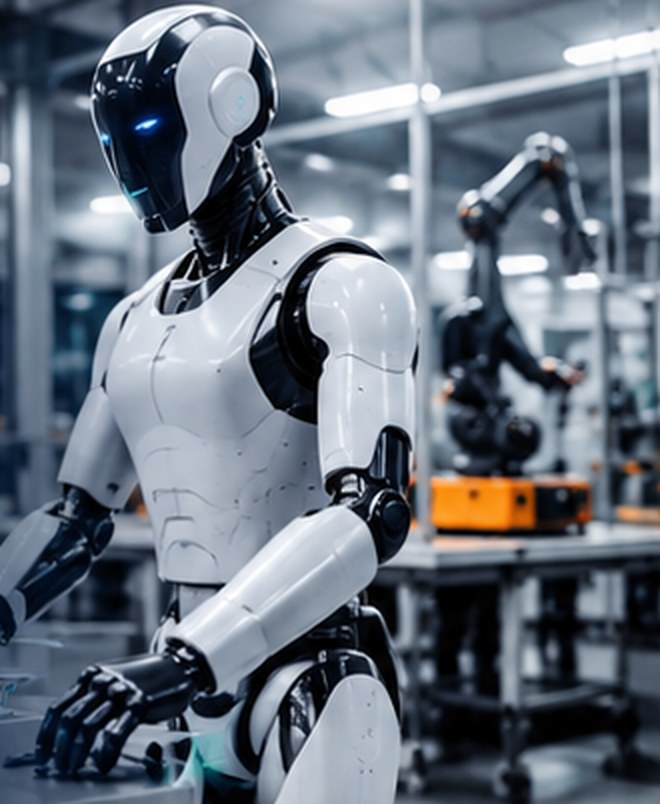
Few technologies produce as much excitement, or as much confusion, as the humanoid robot. Every week brings a new clip: a robot striding across a warehouse, folding a shirt, sparring in a ring. The footage is usually real. What it rarely tells you is what the robot can do on an ordinary Tuesday, unaided, when nobody is filming. This guide sets out what humanoids are, why engineers bother with the human shape, and where the line between capability and hype sits as of October 2026. For prices and where to buy, see our separate guide to humanoid prices and availability.
What counts as a humanoid robot?
A humanoid is a robot with a broadly human body plan: a torso, two arms, usually two legs and a head packed with cameras and sensors. Looks are not the point. The point is that it is meant to work in places built for people, using the same doors, stairs, shelves and tools.
That sets it apart from the industrial robot arm, which has dominated factories for decades. An arm is bolted to the floor, extremely precise and built to repeat one job millions of times. A humanoid is mobile and meant to be general-purpose, which is exactly what makes it so hard to build well.
Why bother with the human shape?
The case for humanoids is an argument about infrastructure. Factories, warehouses, hospitals and homes are all designed around human bodies, so a robot that fits them needs no rebuilding of the world around it. Figure makes this case about its work at BMW, where it says moving parts while walking and pulling a heavy cart is a job fixed automation or a standard six-axis arm cannot do.
The counter-argument is just as strong. If a task is the same every time, a specialised machine will almost always be cheaper, faster and more reliable. Some analysts, including the electric vehicle site Electrek, expect humanoids to remain a small slice of robotics overall. So the realistic target is messy, variable work that has so far resisted automation, not the welding line.
What today's humanoids can actually do
Narrow, repetitive work, for real. Agility Robotics' Digit has the longest working record. The company says Digit 4 has logged more than 65,000 operational hours at customer sites including GXO, Schaeffler, Amazon and Toyota, and passed 100,000 totes moved at a GXO warehouse near Atlanta at around 98% accuracy. That is genuine paid work, but it is one kind of task: moving plastic boxes.
Structured factory jobs. Figure says its earlier Figure 02 helped with the production of 30,000 cars at BMW's Spartanburg plant in 2025, and that Figure 03 has moved on to "sequencing", picking parts that arrive in slightly different positions and placing them in order for the assembly line.
Walking, balance and showmanship. These are increasingly solved. Most humanoids shipped today are not doing industrial work at all. Research firm Counterpoint says more than 22,000 humanoids shipped in the first half of 2026, led by China's AgiBot and Unitree, and that over 60% went to entertainment and performance, or research and data collection.
What they still can't do
Generalise. This is the big one. Electrek, reporting on The Information's investigation in September, said Tesla's Optimus could not yet reliably handle a wide range of tasks, and could take several days to learn even basic ones. Elon Musk himself said in October there was "quite a lot of work to do" before Optimus is truly useful for open-ended tasks, as we covered in our report on Optimus production.
Work freely alongside people. Writing in IEEE Spectrum, Agility explained that Digit 4 had to work behind physical barriers, separated from people at all times, to satisfy insurance and regulatory demands. Digit 5 is designed to work without cages, but that has yet to be proven at scale.
Dexterous, reliable hands. Hands remain a weak point. Tesla's Optimus hand reportedly contains more than 100 small parts that are still assembled by hand, and some of its touch sensors have had reliability problems.
Housework. No humanoid can yet tidy an unfamiliar home on its own. 1X's NEO, the most prominent home robot, relies on a remote 1X operator for tasks it hasn't learned, and the company has said it initially won't handle anything hot, heavy or sharp. Our look at NEO has the details.
Reality check: demo or deployment?
The most useful skill for reading humanoid news is telling a demo from a deployment. Teleoperation is the hidden variable: Boston Dynamics' own photo of its new Atlas training centre inside a Hyundai plant is captioned as a trainer teleoperating the robot.
| What the headline says | What it usually means | What to ask |
|---|---|---|
| "Watch our robot fold laundry" | A capability demo, often the best take | How many attempts? Was anyone steering it remotely? Was it sped up? |
| "Piloting with a customer" | A trial, frequently supervised | How many robots, for how long, doing what share of the work? |
| "Production has started" | Robots are being built, not necessarily working | Where are they going, and who is paying for them? |
| "X hours in operation, Y accuracy" | The meaningful claim | How often did humans step in? |
The UK angle
In Britain, humanoids are still mainly something you'll see in a university lab, at a trade show or in an industrial trial rather than at home. That could start to change: trade magazine Drives & Controls reports that Agility plans to make Digit 5 available outside North America for the first time, starting with the UK and EU.
The UK's own strengths lie in the parts that decide whether humanoids become useful, such as robot hands, touch sensing, AI and batteries. Cambridge-based Nyobolt, for example, supplies the fast-charging battery that lets Digit 5 recharge in nine minutes. Our spotlight on British robotics looks at where the country stands.
The bottom line
Humanoid robots in 2026 are real, improving fast and still early. They are good at demonstrations and increasingly useful in narrow, structured industrial jobs. They are not yet general-purpose helpers. Treat the videos as evidence of progress rather than proof of arrival, and watch the dull numbers instead: hours worked, tasks per robot, how often a human steps in and what each one costs to run. Those will decide whether humanoids ever pay their way.