
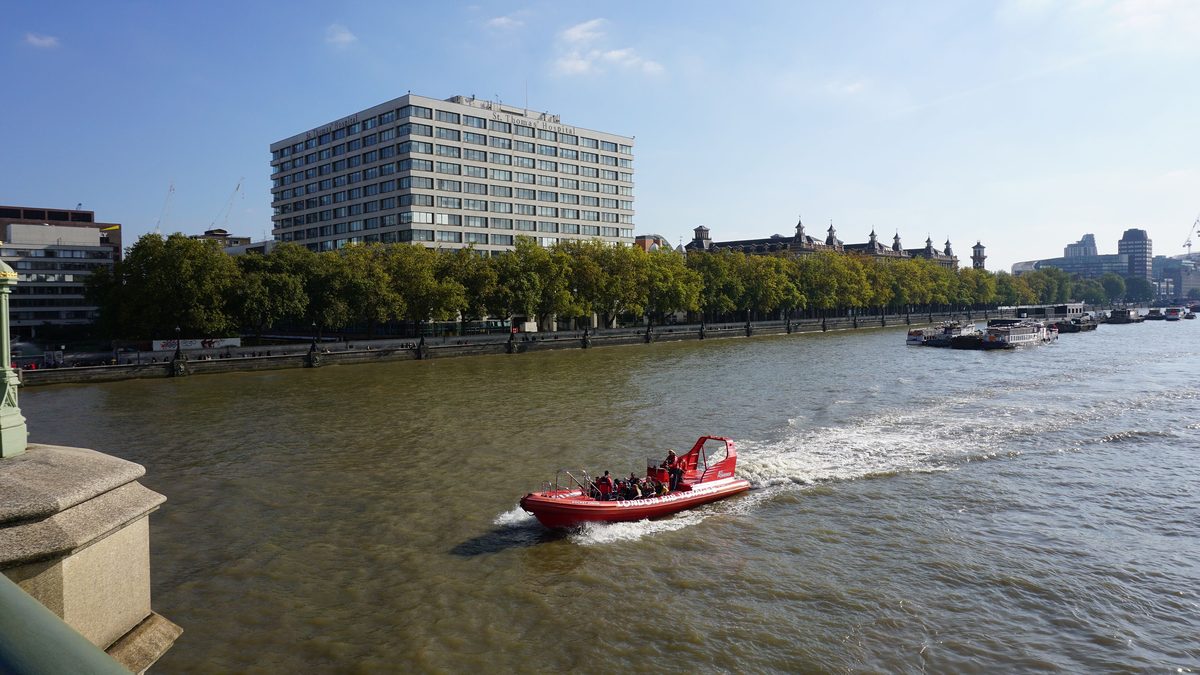
St Thomas' Hospital on the Thames, one end of the drone route. Photo: Bill Boaden / Geograph, via Wikimedia Commons, CC BY-SA 2.0
Every weekday, small electric aircraft cross the sky of central London carrying tubes of blood and bone marrow. They fly about 90 metres up, too high for most people to notice, along corridors approved by the Civil Aviation Authority. A trip that can take a courier more than half an hour through traffic takes a few minutes by air.
Britain's first routine medical drone deliveries started with a narrow job. In October 2024, Guy's and St Thomas' NHS Foundation Trust began flying urgent blood samples between the Synnovis laboratory at Guy's Hospital and the lab at St Thomas' Hospital. The samples came from surgical patients at high risk of complications from bleeding disorders, where a faster result can mean an operation goes ahead sooner. Until then, they travelled by van and motorbike courier.
Who runs it
The service is coordinated by Apian, a London healthcare logistics company founded by NHS doctors. Apian does not build aircraft. It plans the routes, handles the regulatory work and plugs the drones into hospital routines, working with specialist operators that fly them. The 2024 pilot used Wing, the drone delivery company owned by Google's parent Alphabet. In June 2025, Apian added Matternet, a specialist in urban drone delivery, and said the expansion would focus on pathology networks, including the big Synnovis hub at Blackfriars.
By then the pilot had delivered more than 6,000 patient samples. Figures reported by the Standard in February 2026 put the average cost saving of that first phase at 28%, and the cut in carbon dioxide emissions at 98.4% per delivery, compared with urgent ad hoc courier vans. They have not been independently audited, but they explain why other trusts are paying attention.
This autumn: Blackfriars
In September 2026, Synnovis, the pathology partnership run by SYNLAB UK & Ireland, signed a strategic partnership with Apian. Matternet drones would now carry urgent samples from both Guy's and St Thomas' to the Synnovis laboratory hub at Blackfriars. The first flights would carry bone marrow samples used to diagnose and monitor blood disorders such as acute leukaemia, including for children treated at Evelina London Children's Hospital. Apian says deliveries to Blackfriars began in October.
The scale of the destination matters. "Our Blackfriars hub analyses 20,000 samples each day, and each one of those samples represents a patient," said Professor Dominic Harrington, chief scientific officer of SYNLAB UK & Ireland. Mark Dollar, the company's chief executive, called the deal "a strategic investment which will allow us to explore innovation opportunities in robotics, AI and autonomous logistics".
| Route | By road | By drone | Status |
|---|---|---|---|
| Guy's ↔ St Thomas' labs | More than 30 minutes | Under 2 minutes (Wing); about 4 minutes (Matternet) | Since October 2024; more than 6,000 samples |
| Guy's and St Thomas' → Blackfriars hub | Not published | Not published | Matternet flights from October 2026 |
| Raynes Park → St George's, Tooting | About 20 minutes | Just over 3 minutes (Wing) | Since February 2026 |
One detail is easy to blur. The "under two minutes" figure quoted for the original route was achieved by Wing's aircraft. For Matternet's drone on the same hop, Apian's own service page gives approximately four minutes. Both are a fraction of the road time, but they are different aircraft with different numbers.
What the drone is, and isn't
The Matternet M2 is a quadcopter built for small parcels in towns and cities. According to Apian, it carries up to 2kg over distances of up to 20km and flies at nearly 60km/h. It has no cameras. The flights are highly automated along pre-programmed routes, but every one is overseen by a certified pilot in command, and the service runs Monday to Friday, 9am to 4pm. Flights pause in extreme weather.
The next problem is on the ground. A drone that lands on a roof still needs someone to carry its cargo to an analyser. In October, Apian said its wheeled ground robots had delivered more than 1,400 live patient samples during supervised trials at Blackfriars, linking drone landing pads to the lab. Taking out that last human hand-off is what turns a fast flight into a faster result.
Why regulation is the real product
The aircraft are the easy part. When the pilot began, the CAA granted the airspace approval and NATS, the air traffic service, worked to keep the drones safely separated from crewed aircraft. Airspace approval also means coordinating with other users of low-level airspace, such as the police, fire brigades and air ambulances. Each new route needs its own approvals.
That is also why the network is not yet permanent. Apian's service page says the CAA has approved continuing operations between Guy's, St Thomas' and Blackfriars until February 2027. At Great Ormond Street Hospital, trial flights began in July 2026 under an initial six-month approval. These are routine services built on time-limited permissions.
The ambition is older than the flights. In 2020, the government's UK Space Agency described Apian's plan for an "NHS Air Grid": a network of secure air corridors for drone deliveries across the health service. The London routes are the first stretch of it to carry patient samples every working day.
Beyond Guy's and St Thomas'
The model is already spreading. Since February 2026, Wing drones have collected samples from the Nelson Health Centre in Raynes Park and delivered them to the South West London Pathology laboratory at St George's Hospital in Tooting in just over three minutes. The trust says that trip takes about 20 minutes by road. Apian says it is the first time drones have routinely collected samples from an NHS primary care site, and that on some routes they are already up to 23% cheaper than urgent couriers. South West London Pathology wants to link St Helier, Croydon and Kingston hospitals next.
The UK angle
Medical drones are not new, even in Britain: in 2022 NHS England announced Apian's trial flying chemotherapy drugs to the Isle of Wight. What London is testing is different: dense, on-demand flights between city hospitals, folded into NHS pathology networks. It depends on a regulator willing to approve automated flights over a capital city, and on hospitals willing to change how samples leave the ward.
The open questions are economic. Can the cost per sample keep falling as routes are added? Will approvals become standing permissions rather than renewals? And can the ground robots remove enough hand-offs to justify the kit? For now, the corridor is small, specific and real: a handful of routes that carry patient samples every working day.