
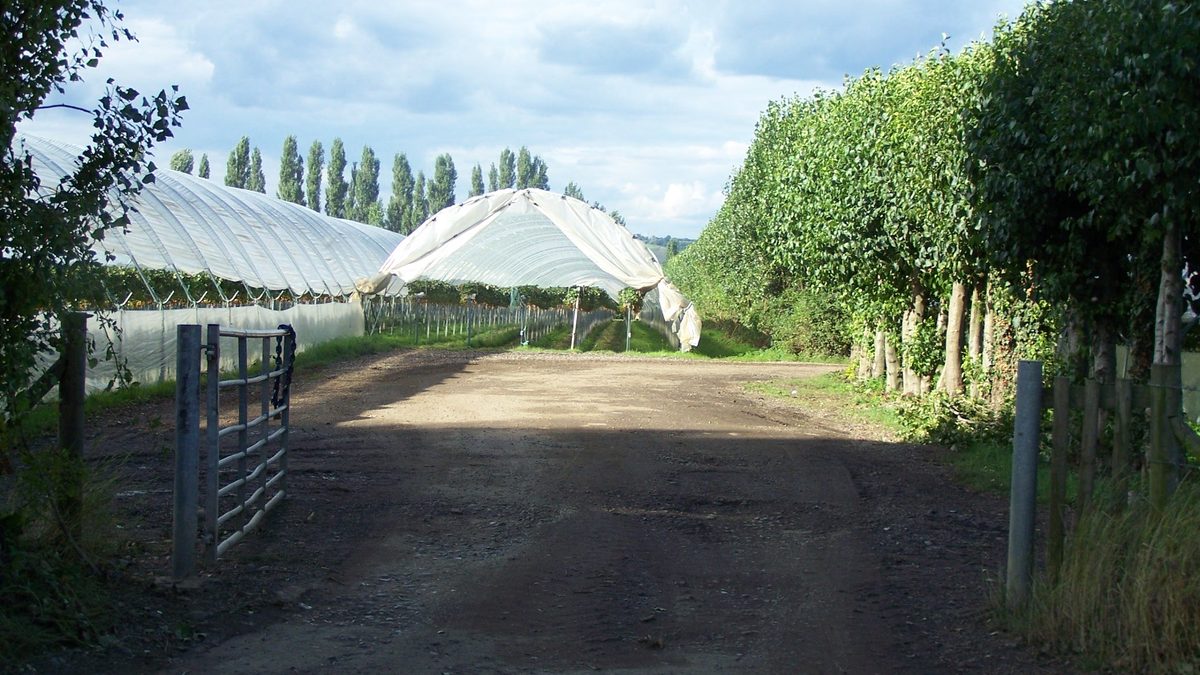
Raspberry polytunnels in Kent, not the Norfolk trial site. Photo: Geoff Pick / Geograph, via Wikimedia Commons, CC BY-SA 2.0
Place UK's farm at Tunstead, near North Walsham in north Norfolk, harvests around 400 tonnes of raspberries a year, from May to November. At the peak of the season it employs up to 630 people. That fruit has traditionally been picked by hand, because few machines can touch a raspberry without damaging it.
That is what Fieldwork Robotics is trying to change. The company began in 2016 as a spin-out from the University of Plymouth and is now based in Cambridge. Its latest machine, the Fieldworker 1, has been working in Place UK's polytunnels, and from 2026 it is part of a two-year programme to see whether robot pickers can earn their keep on a commercial British farm.
Why raspberries are so hard
Raspberries are soft, ripen unevenly and hide behind leaves on tall canes, at different heights. Grip too hard and the berry bruises. Pull at the wrong angle and it tears. "Raspberries are notoriously difficult to harvest, as they can be so easily damaged during the picking process," Dan Yordanov, head of fresh at Place UK, told the Eastern Daily Press. "Traditionally, only human pickers have been able to pick fruit with precision and efficiency."
That difficulty is also why Fieldwork chose raspberries first. When its first prototype was tested in 2019, the University of Plymouth said a system proved on raspberries could be adapted readily for other soft fruits and vegetables.
How the robot picks a berry
The Fieldworker 1 rides along the rows on a self-driving, battery-powered base and carries four picking arms that work at the same time. A camera spots the berries. Fieldwork's chief executive, David Fulton, told the Guardian that the system detects the light a berry gives off at different stages of ripeness, rather than relying on colour alone. Two further cameras at the end of each arm then pinpoint the berry's exact position, and a cup with a soft, inflatable membrane closes around it and pulls it off the plant. Fulton compared the cup to a "pelican mouth" that holds up to three berries, much as a human picker does.
The company's chief technology officer, Sid Shaikh, told Newsweek in July that the robot can sort berries into seven classes of ripeness. That lets a grower pick slightly firmer fruit when it has a long way to travel to the supermarket.
How fast is it, really?
This is where claims need care. Fieldwork says its robots are designed to pick at the same speed and quality as human pickers, but it has not published independent figures to prove it. A 2026 academic review of raspberry robots made the same point: detailed numbers are not public.
The figures that are public tell a story of steady progress. In 2022, the Guardian reported that the earlier four-armed version picked about 1kg of fruit an hour. In July 2026, Shaikh said the machines were on track to harvest about 1.5kg to 2kg an hour, and that in a UK test last year one robot picked a 100-metre row in about 40 minutes. Fieldwork's pitch is not that one robot beats one person, but that robots can work longer hours, including at night, and leave people to pick the berries the machine cannot see or reach.
What the Norfolk trial measures
In 2025, Fieldwork ran a four-week trial programme at Place UK, continuing earlier field trials there. The robot worked in a small area set up to copy the picking schedule and routine of a normal harvest team. The aim was to measure fruit quality and any other effect on the finished product, test software and hardware upgrades, and gather data on night picking. The results feed a "techno-economic analysis" comparing robot and human picking.
In 2026 that became something bigger. Fieldwork is now building production robots for a two-year "harvesting as a service" programme with Place UK and with Littywood Farm in Stafford, funded through Innovate UK's ADOPT scheme. Under that model, growers buy picking as a service rather than buying the robots, and the trials are meant to test logistics, operations and the infrastructure farms would need.
- April 2026: a £2.2 million investment round led by Elbow Beach, alongside £1.7 million in grant funding from Innovate UK and a climate grant.
- June 2026: £300,000 from SEED Innovations, the AIM-quoted investment company chaired by Jim Mellon, on the same terms, as part of a £2.5 million Seed+ fundraise.
- Plan: multi-robot fleets on farms from 2027, subject to the trials, with trials planned in Australia.
The labour question
Growers' interest is driven by cost and shortage: the Eastern Daily Press describes steeply rising labour costs and mounting difficulty recruiting seasonal workers. "Up to 30% of soft fruit is lost due to a shortage of pickers," Mellon said when SEED invested. That is an investor's headline figure rather than an official statistic, and losses vary widely by farm and season, but unpicked fruit is a real cost. Fieldwork says its aim is to complement the workforce, not replace it.
What it means for British farming
The government is betting on the same idea. In August 2026, Defra opened round two of its Farming Futures Automation and Robotics competition, offering up to £20 million for collaborative projects in agriculture, horticulture and forestry, including ones that reduce reliance on seasonal labour. The competition closed on 30 September. It follows Defra's 2022 review of automation in horticulture, which set out how far the technology had to go before it could cut the sector's need for seasonal labour.
There are good reasons for caution. A small trial area in a polytunnel is not a whole season across a whole farm, in rain, with fruit density changing week to week. The company itself describes this as the move from technology validation to commercial trials. The robot is real. The business is not proven yet. If the Norfolk and Staffordshire trials work, the same vision-and-gripper approach could spread to other soft fruit. If they don't, the picker shortage stays.