
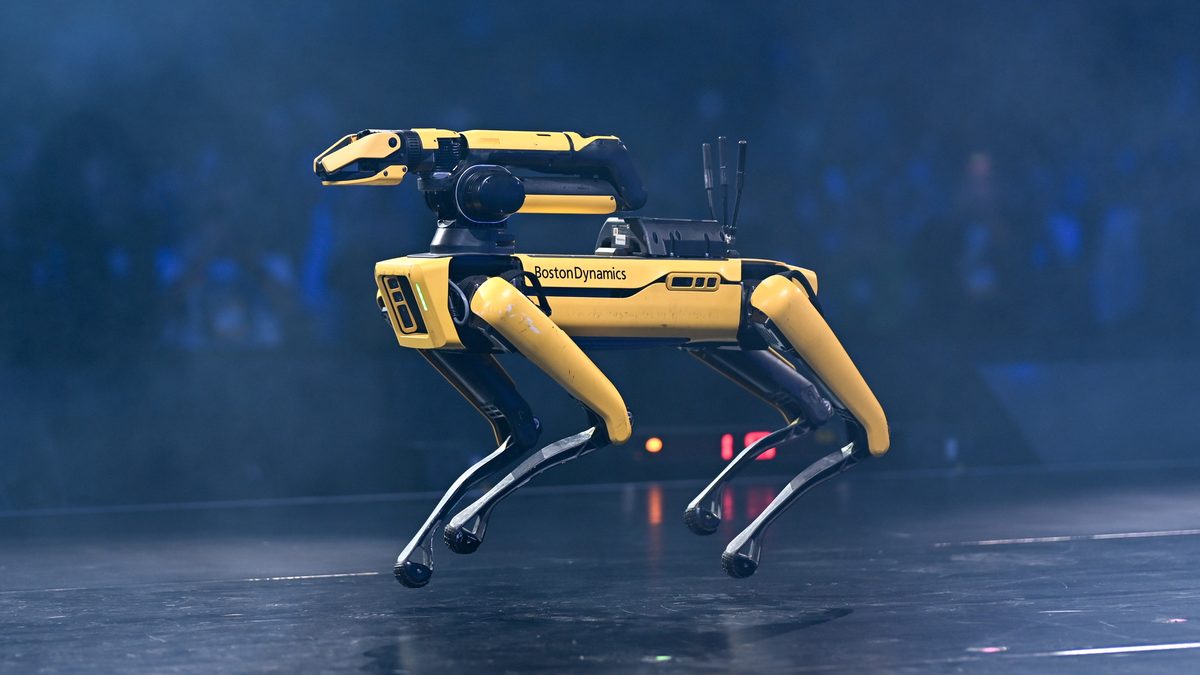
Boston Dynamics Spot on stage at Web Summit 2025 in Lisbon, not on a McLaren site. Photo: Lukas Schulze / Web Summit, via Wikimedia Commons, CC BY 4.0
Construction sites are messy, constantly changing and dangerous. That makes them a hard place to deploy a robot, and an obvious place to try. In July 2026, McLaren Construction, the London-headquartered contractor, announced a partnership with the US robotics company FieldAI to put autonomous four-legged robots to work on its UK sites.
The machines are Boston Dynamics' Spot robot dogs running FieldAI's software. McLaren had already tested them on several live projects, including its Passivhaus refurbishment of the London School of Economics' building at 35 Lincoln's Inn Fields, a scheme the Institution of Mechanical Engineers puts at £100 million. The company's announcement was headlined as a plan to deploy the robots "at scale".
What the robot actually does
The first jobs are about seeing and recording. McLaren says the robots will initially:
- capture 360-degree imagery of the site
- generate point cloud data, a dense 3D scan of what has actually been built
- support progress verification and model-to-site deviation analysis, checking the build against the digital design
- carry out safety compliance patrols and quality assurance
Regular automated scans create a visual and spatial record of work as it is installed. AI-enabled analysis then compares that record with the design model. The point is timing: if a duct or a wall is in the wrong place, it is far cheaper to find out the day it goes in than weeks later, when other trades have built around it. McLaren says it expects earlier identification of installation issues, less rework and a stronger evidence base for compliance and quality assurance. The range of tasks is meant to grow over time.
Why legs, and why software
Spot itself is not new. Boston Dynamics already markets it to the construction industry for progress monitoring and capturing as-built conditions. Legs matter on a building site because the work happens on several floors. A wheeled robot is stopped by a staircase or a pile of offcuts; a quadruped can climb the stairs. "Construction sites are designed for us humans," Kereshmeh Afsari, an associate professor at Virginia Tech who has studied quadrupeds on live sites since 2020, told the IMechE. "We can walk over gaps and go up the stairs, and that's something that a legged robot is very compatible with."
What is different here is the autonomy. FieldAI's "Field Foundation Models", the company says, combine data-driven AI with physics-based reasoning and uncertainty quantification, an approach designed to let a robot judge how confident it is before it acts. McLaren says the software does not depend on prior maps, supporting infrastructure or pre-planned routes, so a robot can be deployed quickly and keep working as the layout changes from week to week.
"The significance of this deployment for the construction industry is that we can move beyond machines that are remote controlled or pre-programmed for a limited range of tasks and routes," said Adam Nicholson, McLaren Construction's group pre-construction director. "Instead, we now have autonomous robots navigating stairs, doors and other obstacles and constantly working with our human teams to support productivity, safety and quality."
The UK angle
The partnership is FieldAI's first move into the UK market. The company, based in Irvine, California, says its construction deployments already span hundreds of sites across Europe, Asia and North America. In August 2025 it announced $405 million raised over two funding rounds, from investors including Bezos Expeditions and NVentures, Nvidia's venture arm, with earlier backing from Gates Frontier and Samsung. In October 2026, Business Insider reported, citing a person familiar with the deal, that FieldAI was raising $700 million at a $10 billion valuation.
For McLaren, robotics is one stage of a five-year digital transformation strategy that began in 2022, and the firm was named Digital Contractor of the Year at the 2026 Digital Construction Awards. The two companies say they will work together to meet UK regulatory and data security requirements as deployments scale up. On a British site, that means questions about who sees the scans, where the data is stored and how a roaming robot fits into a contractor's health and safety plan.
For the wider industry, the pitch is straightforward: fewer hours walking a site with a tablet or clipboard, errors caught earlier and a better record when something is disputed. Whether that turns into real savings is exactly what the McLaren roll-out will test.
The honest caveats
Cost is one. Afsari told the IMechE that a Spot robot cost about $70,000, plus around $22,000 a year for a support package, and that the business case depends on saving enough inspection time, rework or travel to justify it. Cheaper quadrupeds may bring that down.
Safety and liability are another. If a robot roaming on its own damages a building or a piece of equipment, "who's in charge?", Afsari asks. She argues deployments need their own hazard identification, operating procedures and clear lines of responsibility. "These robots improve safety, but these are machines," she says. "Around any machines, new hazards are created."
And "at scale" in a press release is not the same as a robot on every McLaren site tomorrow. The partnership is new, the first tasks are monitoring rather than building, and the robots work alongside site teams rather than replacing them. FieldAI's vice-president of sales, Patrick Purwin, said the work "starts with monitoring and modelling missions and expands across the full spectrum of physical work, including site logistics, dexterous manipulation and multi-robot coordination". That is a longer bet.
Afsari, for one, rejects the idea of robots as straight replacements for site workers: "They're going to help humans do their task better." She also suggests a remotely operated quadruped could open some inspection jobs to people with mobility disabilities who cannot easily cross an unfinished building.
The robot dog on a London refurbishment is real; the transformation of UK construction will take rather longer.